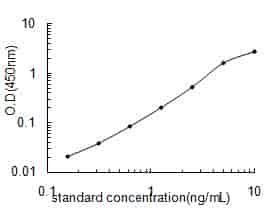
Product Name:Bovine Four and a half LIM domains protein 3, FHL3 ELISA KIT Packing:96T
Catalog No.:ELI-20814b
Gene Name:Bovine Four and a half LIM domains protein 3, FHL3
Detect Range:0.781-50ng/ml
Sensitivity:0.469ng/ml
Target Protein Name:Bovine Four and a half LIM domains protein 3, FHL3
Alternative Name:FHL3,Bovine Four and a half LIM domains protein 3, FHL3 Sample type:serum, plasma, tissue homogenates, cell culture supernates or other biological fluids.
ELISA type:Sandwich ELISA Kit Product Description:Bovine Four and a half LIM domains protein 3, FHL3 ELISA KIT allows for the in vitro quantitative determination of Bovine Four and a half LIM domains protein 3, FHL3 concentrations in serum, plasma, tissue homogenates, cell culture supernates or other biological fluids.
ELISA Test Principle:The microtiter plate provided in Bovine Four and a half LIM domains protein 3, FHL3 ELISA KIT has been pre-coated with an Bovine Four and a half LIM domains protein 3, FHL3 antibody specific to Bovine Four and a half LIM domains protein 3, FHL3 .Standards or samples are then added to the appropriate microtiter plate wells with a biotin-conjugated antibody preparation specific for Bovine Four and a half LIM domains protein 3, FHL3 and then avidin conjugated to Horseradish Peroxidase (HRP) is added to each microplate well and incubated. Then a TMB substrate solution is added to each well. Only those wells that contain Bovine Four and a half LIM domains protein 3, FHL3, biotin-conjugated antibody and enzyme-conjugated Avidin will exhibit a change in color. The enzyme-substrate reaction is terminated by the addition of a sulphuric acid solution and the color change is measured spectrophotometrically at a wavelength of 450 nm.The concentration of Bovine Four and a half LIM domains protein 3, FHL3 in the samples is then determined by comparing the O.D. of the samples to the standard curve.
NOTE:FOR RESEARCH USE ONLY; NOT FOR THERAPEUTIC OR DIAGNOSTIC APPLICATIONS! PLEASE READ ENTIRE PROCEDURE!
The quality assurance and experimental performance of this biological reagent are rigorously optimized and standardized according to its specific technical pathway: Double Antibody Sandwich Method (双抗体夹心法). This ensures maximum reproducibility across clinical research and scientific workflows.