pET-28a Plasmid Vector | E. coli Expression | Kanamycin Resistance | Catalog PVT0072
pET-28a – E. coli Protein Expression Vector
Catalog No. PVT0072
Packaging: 2µg
Format: Plasmid DNA in TE
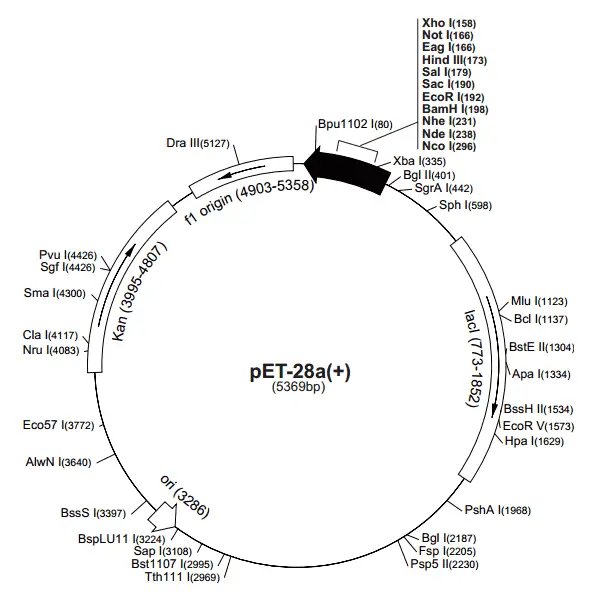
Figure 1. pET-28a circular vector map (5369 bp). Click to enlarge.
Copy Number
High (40–60/cell)
Resistance
Kanamycin (Kan)
Expression Host
E. coli BL21(DE3)
Fusion Tags
N-His, N-T7, C-His
📄 Download sequence file & Vector Map
Complete sequence file with vector map, full nucleotide sequence, multiple cloning site details, restriction enzyme list, and annotation file.
Formats: ZIP (GenBank + Vector Map) | PDF Manual | Last Updated: May 2026
Product Overview
The pET-28a vector is one of the most widely used E. coli protein expression plasmids in molecular biology and structural biology research. Originally developed by Novagen (EMD Biosciences / Merck), the pET system has become the gold standard for high-level, IPTG-inducible recombinant protein expression in bacterial hosts.
pET-28a combines the powerful T7/lac hybrid promoter system with an N-terminal His-Tag, T7-Tag, and thrombin cleavage site, plus an optional C-terminal His-Tag for dual-tag purification strategies. This makes it exceptionally versatile — allowing researchers to express and purify target proteins via Ni-NTA affinity chromatography, and then remove the N-terminal fusion tags with thrombin protease if desired.
With a high copy number (approximately 40–60 copies per cell, based on the pBR322 origin of replication), pET-28a ensures robust plasmid yield during preparation and supports high-level target gene expression upon IPTG induction in DE3 lysogen strains such as BL21(DE3).
Key Features
- T7/lac Hybrid Promoter: Provides tight, IPTG-inducible control of target gene transcription, minimizing basal expression and toxicity.
- Dual His-Tag System: N-terminal and C-terminal His-Tags (6×His) enable Ni-NTA affinity purification from either terminus, offering cloning flexibility.
- Thrombin Cleavage Site: The N-terminal fusion tags can be cleanly removed by thrombin digestion (Leu-Val-Pro-Arg↓Gly-Ser).
- T7-Tag (MASMTGGQQMG): Enables detection and quantitation by anti-T7-Tag antibodies for Western blot and ELISA applications.
- Kanamycin Resistance: Confers resistance to kanamycin (30–50 µg/mL), a stable and widely available selection marker.
- High Copy Number: pBR322 origin yields 40–60 copies per cell for high plasmid DNA recovery.
- Multiple Cloning Site (MCS): Contains 18+ unique restriction sites for versatile cloning strategies.
- lacI Repressor Gene: Encoded on the plasmid backbone for host-independent repression of the T7/lac promoter.
Technical Specifications
| Property |
Value |
| Plasmid Type |
E. coli Expression Vector |
| Vector Size |
5369 bp |
| Copy Number |
High (pBR322 origin, ~40–60 copies per cell) |
| Promoter |
T7/lac hybrid promoter (IPTG-inducible) |
| Antibiotic Resistance |
Kanamycin (Kanr), 30–50 µg/mL working concentration |
| N-terminal Tags |
6×His-Tag, T7-Tag (MASMTGGQQMG), Thrombin Cleavage Site |
| C-terminal Tag |
6×His-Tag (optional, removable by introducing stop codon) |
| Cloning Method |
Restriction enzyme digestion & ligation via MCS |
| 5' Sequencing Primer |
T7 Promoter: 5'-TAATACGACTCACTATAGGG-3' |
| 3' Sequencing Primer |
T7 Terminator: 5'-GCTAGTTATTGCTCAGCGG-3' |
| Recommended Host Strain |
BL21(DE3), BL21(DE3)pLysS, Rosetta(DE3), Origami(DE3) |
| Storage |
-20°C (short-term); -80°C (long-term) |
| Biosafety Level |
BSL-1 |
Multiple Cloning Site (MCS)
The pET-28a MCS contains unique restriction enzyme recognition sites arranged sequentially downstream of the N-terminal fusion tags and thrombin cleavage site. The following restriction enzymes are available for cloning:
NcoI | BamHI | EcoRI | SacI | SalI | HindIII | NotI | XhoI | NdeI | NheI | BglII | PstI | PvuII | SmaI | XbaI
Note: pET-28a differs from pET-28b(+) and pET-28c(+) only in the translational reading frame of the MCS relative to the N-terminal tags. Select the variant that places your target gene in the correct reading frame.
Application Guide & Protocols
1. Recommended Expression Workflow
-
Clone Target Gene into MCS: Digest pET-28a and insert DNA with compatible restriction enzymes. Ligate and transform into a standard cloning strain (e.g., DH5α). Verify the construct by colony PCR, restriction digestion, and Sanger sequencing using T7 Promoter and T7 Terminator primers.
-
Transform into Expression Host: Transform the verified plasmid into BL21(DE3) or a compatible DE3 lysogen strain. Plate on LB agar containing 50 µg/mL kanamycin and incubate at 37°C overnight.
-
Small-Scale Expression Screening: Pick a single colony and inoculate 3–5 mL LB + Kan (50 µg/mL). Grow at 37°C, 220 rpm until OD600 = 0.6–0.8. Induce with 0.1–1.0 mM IPTG. Test expression at various temperatures (16°C, 25°C, 30°C, 37°C) and durations (2–20 hours).
-
Scale-Up & Harvest: Scale the optimized conditions to desired culture volume. Harvest cells by centrifugation at 4000 × g, 4°C, 15 min. Cell pellets may be stored at -80°C or processed immediately.
-
Ni-NTA Affinity Purification: Resuspend pellet in lysis buffer (50 mM Tris-HCl pH 8.0, 300 mM NaCl, 10 mM imidazole, 1 mM PMSF). Lyse by sonication or French press. Clarify at 12000 × g, 4°C, 30 min. Apply supernatant to Ni-NTA resin. Wash with 20–50 mM imidazole. Elute with 250–500 mM imidazole.
-
Optional Tag Removal: Dialyze or buffer-exchange purified protein into thrombin cleavage buffer (20 mM Tris-HCl pH 8.4, 150 mM NaCl, 2.5 mM CaCl2). Add thrombin protease (1 U per mg of target protein). Incubate at room temperature for 2–16 hours. Remove cleaved tags and thrombin by re-passing through Ni-NTA and/or benzamidine resin.
2. IPTG Induction Optimization
| Parameter |
Recommended Range |
Starting Recommendation |
| IPTG Concentration |
0.01–1.0 mM |
0.5 mM |
| Induction OD600 |
0.4–1.0 |
0.6–0.8 |
| Post-Induction Temperature |
16–37°C |
30°C (soluble proteins)
37°C (insoluble/inclusion bodies) |
| Post-Induction Duration |
2–20 hours |
4 hours (37°C)
16 hours (16–25°C) |
| Kanamycin Concentration |
30–50 µg/mL |
50 µg/mL |
3. Troubleshooting Common Issues
| Issue |
Possible Cause |
Solution |
| No / low protein expression |
Incorrect reading frame or promoter incompatibility |
Verify construct by sequencing; confirm use of DE3 lysogen host |
| Protein in inclusion bodies |
Expression rate too high; incorrect folding |
Lower IPTG to 0.1 mM; reduce induction temperature to 18–25°C; use BL21(DE3)pLysS |
| Leaky expression (toxicity) |
Basal transcription from T7 promoter |
Add 1% glucose to culture medium; use BL21(DE3)pLysS; use pLysS or pLysE strains |
| Poor Ni-NTA binding |
His-Tag buried or degraded |
Add 10–20 mM imidazole to lysis buffer; include protease inhibitors; try C-terminal His-Tag |
| Low plasmid yield |
Degraded or contaminated preparation |
Use fresh transformant; verify Kan selection; use endA- host for plasmid prep |
Comparison: pET-28a vs pET-28b(+) vs pET-28c(+)
The three pET-28 variants — a(+), b(+), and c(+) — are identical in backbone sequence, antibiotic resistance, promoter system, and fusion tags. The only difference is the translational reading frame of the multiple cloning site (MCS) relative to the N-terminal His-Tag / T7-Tag / thrombin site fusion. This creates a set of three vectors that allow cloning into all three possible reading frames, ensuring that at least one vector will produce an in-frame fusion with the N-terminal tags regardless of the restriction sites used.
Recommendation: If your target gene lacks convenient restriction sites compatible with pET-28a, consider pET-28b(+) or pET-28c(+) for alternative reading frames. All three vectors are available on lifescience-market.com.
Frequently Asked Questions
Q1: What is the difference between pET-28a and pET-28b(+)/pET-28c(+)?
The three vectors differ only in the reading frame of the MCS relative to the N-terminal fusion tags. They share identical backbone sequences, resistance markers, and expression control elements. Select the variant that provides the correct reading frame for your target gene.
Q2: What is the recommended host strain for pET-28a expression?
BL21(DE3) is the most widely used strain. For toxic or difficult-to-express proteins, use BL21(DE3)pLysS for tighter expression control. For codon optimization, Rosetta(DE3) strains provide tRNAs for rare codons. For disulfide-bonded proteins, Origami(DE3) strains support cytoplasmic disulfide bond formation.
Q3: Can I remove the His-Tag after purification?
Yes. The N-terminal His-Tag can be cleaved using thrombin protease, which recognizes the Leu-Val-Pro-Arg↓Gly-Ser site between the T7-Tag and the MCS. The C-terminal His-Tag can be excluded by engineering a stop codon at the 3' end of your gene during cloning.
Q4: What is the copy number of pET-28a?
pET-28a is a high-copy-number plasmid maintained at approximately 40–60 copies per E. coli cell, due to the pBR322 origin of replication.
Q5: How should I store the plasmid upon receipt?
Upon receipt, centrifuge the tube briefly to collect the DNA solution. Store at -20°C for routine use (up to 6 months) or at -80°C for long-term storage. Avoid repeated freeze-thaw cycles. An aliquot may be kept at 4°C for up to 2 weeks.
Q6: What kanamycin concentration should I use?
Use 50 µg/mL kanamycin for standard LB agar plates and liquid cultures. For some E. coli strains, 30 µg/mL may be sufficient. Fresh kanamycin stocks (50 mg/mL in water, filter-sterilized, stored at -20°C) should be used.
Q7: Does pET-28a contain the lacI repressor gene?
Yes. The lacI gene is encoded on the pET-28a plasmid backbone, enabling host-independent repression of the T7/lac promoter. This reduces basal expression even in hosts lacking a chromosomal lacI copy.
Q8: Can pET-28a be used for in vitro transcription/translation?
Yes. The T7 promoter supports in vitro transcription using T7 RNA polymerase. Combined with an E. coli S30 extract or a reconstituted translation system, pET-28a constructs can be used for cell-free protein expression.
Related Products
Recommended Expression Host Strains
Related pET Vectors
Accessories & Reagents
⚠️ Important Notice
- This product is FOR RESEARCH USE ONLY! Not for use in diagnostic or therapeutic procedures.
- Upon receipt, centrifuge the tube briefly and store immediately at -20°C or -80°C as recommended.
- Use appropriate biosafety level (BSL-1) practices when handling this product.
Alternative Names & Synonyms
pET28a, pET-28a, pET28a(+), pET-28a vector, pET28a plasmid, pET-28a expression vector, Novagen pET-28a, His-Tag expression vector, T7 promoter plasmid, Kanr expression vector
 English